Eretz Israel is our unforgettable historic homeland...The Jews who will it shall achieve their State...And whatever we attempt there for our own benefit will redound mightily and beneficially to the good of all mankind. (Theodor Herzl, DerJudenstaat, 1896)

We offer peace and amity to all the neighbouring states and their peoples, and invite them to cooperate with the independent Jewish nation for the common good of all. The State of Israel is ready to contribute its full share to the peaceful progress and development of the Middle East.
(From Proclamation of the State of Israel, 5 Iyar 5708; 14 May 1948)

With a liberal democratic political system operating under the rule of law, a flourishing market economy producing technological innovation to the benefit of the wider world, and a population as educated and cultured as anywhere in Europe or North America, Israel is a normal Western country with a right to be treated as such in the community of nations.... For the global jihad, Israel may be the first objective. But it will not be the last. (Friends of Israel Initiative)
Showing posts with label Jordan and the Palestinian Arabs. Show all posts

Friday, 14 September 2018

David Singer: Trump Squeezes UNRWA, Checkmates PLO and Incentivises Jordan

Here's the latest article by Sydney lawyer and international affairs analyst David Singer.

He writes:

President Trump has created a veritable diplomatic tsunami affecting the political fortunes of the Palestine Liberation Organisation (PLO), Hamas and Jordan – with his decision to cease all future donations to the United Nations Relief and Works Agency (UNRWA) – currently US$360million per annum and comprising about 30 percent of UNRWA’s budget.

The numbers of UNRWA-registered Palestinian Arab refugees in Jordan, the West Bank and Gaza have been increasing in leaps and bounds annually because they include all the descendants of those Palestinian Arabs caught up in the 1948 and 1967 Arab-Israel wars.

Currently:
  • 2,175,000 live in Jordan – 370,000 of whom reside in 10 camps
  • 810,000 live in the West Bank – 200,000 of whom reside in 19 camps
  • 1,300,000 live in Gaza – 580,000 of whom reside in 8 camps
UNRWA only provides services to the camps. UNRWA does not administer or police the camps, as this is the responsibility of the host authorities.

Jordan, the West Bank and Gaza comprise 83 per cent of the territory of former Palestine.

For UNRWA to count as “refugees” people who are now living in Arab-controlled parts of the same country where their forebears once resided – is really an insult to one’s intelligence.

For UNRWA to tolerate a system of apartheid and segregation that allows those “refugees” to be divided into camp dwellers and non-camp dwellers makes a mockery of the humanitarian principles espoused by the United Nations and the United Nations Human Rights Council.

Struggling under an accumulated deficit of US$271 million before Trump’s hammer blow – UNRWA had already shut down or slated for closure many programs and laid off large numbers of employees – mainly Palestinian Arabs.

The further cuts UNRWA will now be forced to make following America’s defunding will be critical to the PLO, Hamas and Jordan – as “refugees” coming under their respective jurisdictions affected by substantial cuts to their well-established entitlements see others not similarly subjected.

UNRWA funding decisions cannot possibly please all these “refugees” – and those receiving UNRWA aid in Lebanon and Syria.

The PLO, Hamas and Jordan will be lobbying furiously for UNRWA funding cuts to not be made to “refugees” living under their governance. Serious political consequences could ensue if they fail.
Jordan – enjoying a long-standing peace treaty with Israel – currently houses 50 percent of the total of UNRWA registered Palestinian Arab “refugees” in the West Bank, Gaza and Jordan.

Jordan – 70 per cent of whose population comprises Palestinian Arabs or their descendants formerly living in Palestine west of the Jordan River – is eminently qualified to enter into direct negotiations with Israel to recover territory lost by it in the West Bank to Israel in the 1967 Six Day War.

Successful negotiations would enable Jordan to:
  • close the 29 refugee camps in Jordan and the West Bank currently housing 570,000 “refugees”
  • fully rehabilitate and integrate all 2,985,000 “refugees” within the general Arab populations residing in the West Bank and Jordan
  • extend Jordanian citizenship to all West Bank Arab residents
Trump’s promise of direct American bilateral assistance to Jordan would facilitate this outcome.
In one fell swoop – Trump has:
  • Squeezed UNRWA into making refugee-relief choices that could affect the political futures of the PLO, Hamas and Jordan
  • Checkmated the PLO’s claim to continue to be the sole spokesman for the Palestinian Arabs because it lacks absolute authority to influence how UNRWA reduces current funding to the Palestinian Arab “refugees” living in Gaza and Jordan
  • Incentivised Jordan to fill the diplomatic void left by the PLO by agreeing to begin negotiations with Israel on Trump’s peace plan without any preconditions
Bucking – not backing – Trump is a sure-fire recipe for committing political suicide.

Author’s note: The cartoon – commissioned exclusively for this article—is by Yaakov Kirschen aka “Dry Bones”- one of Israel’s foremost political and social commentators –  whose cartoons have graced the columns of Israeli and international media publications for decades. His cartoons can be viewed at Drybonesblog

Monday, 22 January 2018

"Abbas is Making Himself Irrelevant" (video)

Former US ambassador to the UN John Bolton condemns Abbas's speech (be sure to see previous post by David Singer), sniffs an appeal to antisemitism within it, and suggests that Jordan's King Abdullah should take over parts of the West Bank ...

https://www.youtube.com/watch?v=41dMB_EFP5s

Monday, 27 November 2017

David Singer: United Nations Loses the Plot in Ignoring Israel-Jordan Reality

Here's the latest article by Sydney lawyer and international affairs analyst David Singer.

He writes:

29th November 2017 marks the 70th anniversary of United Nations General Assembly Resolution 181 (II) (Resolution) calling for the creation in Western Palestine of independent Arab and Jewish States and a Special International Regime for the City of Jerusalem (Partition Plan).

The Resolution did not mention:
· the “West Bank” (a term dreamt-up in 1950) – using instead the terms “Judea” and “Samaria” - their correct geographical place names for the previous 3000 years
· a “Palestinian State” – only an “Arab State”
· one Arab State had already been created in Eastern Palestine on 25 May 1946 named the Hashemite Kingdom of Transjordan covering 78% of the territory comprised in the 1922 League of Nations Mandate for Palestine (Mandate).
The Partition Plan was accepted by the Jews but vehemently rejected by the Arabs.

H. R. H. Amir FAISAL AL SAUD (Saudi Arabia) fulminated:
We have felt, like many others, the pressure exerted on various representatives of this Organization by some of the big Powers in order that the vote should be in favour of partition. For these reasons, the Government of Saudi Arabia registers, on this historic occasion, the fact that it does not consider itself bound by the resolution adopted today by the General Assembly. Furthermore, it reserves to itself the full right to act freely in whatever way it deems fit, in accordance with the principles of right and justice. 
Mr. JAMALI (Iraq) protested:
In the name of my Government, I wish to state that it feels that this decision is antidemocratic, illegal, impractical and contrary to the Charter. It contradicts the spirit and letter of the Charter. Therefore, in the name of my Government, I wish to put on record that Iraq does not recognize the validity of this decision, will reserve freedom of action towards its implementation, and holds those who were influential in passing it against the free conscience of mankind responsible for the consequences. 
 Amir ARSLAN (Syria) joined the chorus:
Gentlemen, the Charter is dead. But it did not die a natural death; it was murdered, and you all know who is guilty.
My country will never recognize such a decision. It will never agree to be responsible for it. Let the consequences be on the heads of others, not on ours. 
H. R. H. Prince Seif El ISLAM ABDULLAH (Yemen) was just as condemnatory:
The Yemen delegation has stated previously that the partition plan is contrary to justice and to the Charter of the United Nations. Therefore, the Government of Yemen does not consider itself bound by such a decision for it is contrary to the letter and spirit of the Charter. The Government of Yemen will reserve its freedom of action to-wards the implementation of this decision.
This implacable Arab rejectionism was the catalyst for the 1948 invasion of Western Palestine by six Arab armies and the perpetuation of the Arab-Jewish conflict for the next 70 years.

2017 sees:
· Iraq, Syria and Yemen as failed states - with Saudi Arabia in danger of joining them.
· The General Assembly sinking in quicksand of its own making after creating “The Committee on the Exercise of the Inalienable Rights of the Palestinian People” in 1975 and adopting countless resolutions using emotive and artificially-contrived terms such as:
· “West Bank”
· “Occupied Palestinian Territory”
· “historic Palestine”
· “Palestinian People”
· “Palestinians”
· “Palestinian State”
· “two-state solution”
 The United Nations continues to lose the plot whilst it:
(i) Uses such deceptive and misleading language
(ii) Fails to recognise that Jordan and Israel are the two successor states currently exercising sovereignty in 95% of former Palestine.
The United Nations must resurrect 1947 reality and abandon 2017 fiction.

Monday, 7 August 2017

David Singer: Trump, Israel, Jordan and Egypt Can Redress Obama-PLO Debacle

Here's the latest article by Sydney lawyer and international affairs analyst David Singer.

He writes:

President Trump continues to ponder the way forward to end the 100-years-old conflict between Arabs and Jews – as negotiations between Israel and the Palestine Liberation Organisation (PLO) – stalled since April 2014 – show no sign of being resumed.

Negotiations between Israel and the Palestinian Authority under the Oslo Accords and the Bush Roadmap - endorsed by Russia, the European Union and the United Nations - were consigned to the graveyard of history after PLO Chairman Mahmoud Abbas unilaterally disbanded the Palestinian Authority on 3 January 2013.

White House Senior Advisor Jared Kushner has been quoted in an off-the-record discussion saying: 
"there may be no solution".
There may however be a solution should Jordan and Egypt – Israel’s immediate neighbours – agree to negotiate with Israel to end the Jewish-Arab conflict.

Filling this potentially explosive negotiating void with Jordan and Egypt will require Trump to first articulate:
1. the parameters and
 2. The fact-based framework
within which such new negotiations should actually be undertaken

The parameters should be restricted to resolving the competing Arab and Jewish claims to sovereignty in the remaining 5 per cent of the territory of the former Mandate for Palestine – Judea and Samaria (the West Bank), East Jerusalem and Gaza – where internationally-recognised sovereignty still remains undetermined (“the disputed territories”).

Conflicting narratives paralysing previous negotiations must be replaced by Trump with a different fact-based framework underpinning any new negotiations  – including:

1. Jordan and Egypt:
· signatories to peace treaties with Israel in 1994 and 1979 respectively and
 · the last Arab States to occupy the disputed territories between 1948 and 1967
are the best Arab interlocutors to determine with Israel the allocation of sovereignty in the disputed territories.
2. The PLO Charter calling for the destruction of both Israel and Jordan disqualifies the PLO from participating in such new negotiations.
3. Hamas – designated as a terrorist organisation by Israel and banned in Jordan – must be excluded from these new negotiations.
4. The new negotiations are being undertaken to resolve the “Jewish-Arab conflict” that began in 1915 – not “the Israeli-Palestinian conflict” that began in 1948
5. Sovereignty in the territory of the Mandate for Palestine has already been granted to Israel (17 per cent), Jordan (78 per cent) – with sovereignty in Judea and Samaria [West Bank], East Jerusalem and Gaza (5 per cent) still undetermined.
6. The Jewish people is legally entitled to reconstitute the Jewish National Home in the disputed territories by close settlement under Article 6 of the 1922 Mandate for Palestine and article 80 of the United Nations Charter  – subject to the civil and religious rights of the non-Jewish communities living there being safeguarded.
7. Misleading and deceptive language referring to the disputed territories as “occupied territory” or “Occupied Palestinian Territories” fail to recognise that it was Jewish occupation in the disputed territories that was first abruptly ended in 1948 – after every single Jew then living there was forcibly driven out by six invading Arab armies and not allowed to return until after the Six Day War in 1967.
Trump has a hard row to hoe in formulating this critical framework  – but do it he must if there is to be any hope of advancing peace in the Middle East.

Such Trump-defined parameters and fact-based framework need to then be mutually agreed by Jordan, Egypt and Israel before formal negotiations can commence.

Any fanfare trumpeting yet another round of negotiations without such tripartite agreement will inevitably see those new negotiations being eventually buried alongside the graves housing the failed Oslo-Roadmap and stalled Israel-PLO negotiations.

Trump, Israel, Jordan and Egypt working together can certainly succeed where Obama and the PLO ignominiously failed.

Thursday, 23 March 2017

David Singer: Trump Can Broker Israel-Jordan Deal but No Israel-PLO Agreement

Here's the latest article by Sydney lawyer and international affairs analyst David Singer.

He writes:

President Trump’s Special Representative for International Negotiations – Jason Greenblatt – has returned from his wide-ranging meetings in Jerusalem, Ramallah, Amman and Jericho with zero prospects of Trump brokering a deal between Israel and the PLO.

However Greenblatt’s belief in the pivotal role Jordan can play in resolving the 100 years old Jewish-Arab conflict was apparent in his tweet after meeting Jordan’s King Abdullah II:
“We agree on the need for peace between Israelis and Palestinians. Jordan an important ally in this effort.”
According to the Jordan Times:
"During the meeting, held at Al Husseiniya Palace, His Majesty stressed the US role in ending the stalemate in the Palestinian-Israeli peace process and reviving negotiations that should lead to a just and comprehensive solution to the conflict, based on the two-state formula.He asserted that reaching a just deal of a comprehensive peace that includes establishing a Palestinian state will reflect on efforts to achieve peace, security and stability in the region.” 
King Abdullah is whistling in the wind in believing another Arab state could still be established – in addition to Jordan – in the territory comprised in the Mandate for Palestine where Israel presently exercises sovereignty in 17 per cent and Jordan 77 per cent – whilst sovereignty remains undetermined in the last 6 per cent – the West Bank (Judea and Samaria) and Gaza.

Negotiations between Israel and the PLO to create that second Arab State have extended over the last 24 years and been dormant since April 2014.

Those negotiations have failed because Israel and the PLO have been unable to resolve core demands despite two offers having been made by Israel in 2000/2001 and 2008 to cede its claims in over 90 per cent of the West Bank. Israel’s unmet demands are that:
1. The PLO recognise Israel as the nation state of the Jewish people
2. The major Jewish settlement blocs in Judea and Samaria be incorporated into the boundaries of Israel
3. Israel retains security control over the Jordan Valley
4. Jerusalem remains the eternal undivided capital of Israel
5. Any such State be demilitarized
The PLO’s unmet demands are that:
1. The Palestinian State be granted sovereignty over all of the territory of the West Bank with its capital being located in East Jerusalem.
2. All Jewish settlements located in the West Bank and East Jerusalem be dismantled and their inhabitants be removed.
3. Palestinian Arab refugees who fled the 1948 Arab invasion of Western Palestine be allowed to return and settle in Israel.
Trumps’s ability to cut a deal in the face of these irreconcilable differences is severely hampered by the written commitments made to Israel’s Prime Minister Sharon by President Bush on 14 April 2004 and overwhelmingly endorsed by the US House of Representatives by 407:9 and Senate 95:3.

Those commitments – given to Israel to secure Israel’s total withdrawal from Gaza and four Jewish settlements in Judea and Samaria – back Israel’s above demands in any negotiations with the PLO.It seems inconceivable that Trump – the master deal-maker – would consider reneging on the Bush- Congress-Sharon deal.

If he did, Israel would not resume negotiations with the PLO.

If he doesn’t, the PLO would not resume negotiations with Israel.

If Trump wants to do a deal, he needs Jordan to come to the party and enter into direct negotiations with Israel to allocate sovereignty in the West Bank between Jordan and Israel – virtually completing the original two-state formula envisaged in 1922 by Article 25 of the League of Nations Mandate.

Greenblatt’s meeting with King Abdullah is a possible pointer to getting such negotiations underway.

Trump’s undoubted brokering skills can ensure such negotiations happen.

Tuesday, 9 June 2015

"The World Has Been Living With A Two-State Solution For Decades"

Sydney lawyer and international affairs analyst David Singer, who of course is no stranger to regular readers of this blog, has long contended that "Jordan is Palestine".

That thesis is the raison d'être of his blog here

Now, in an important article, Geoffrey Clarfield and Salim Mansur have written a clear and cogent exposition of that view,  argued not only  by David Singer but by others.

Indeed, in their article the authors cite the opinion of another person who will be no stranger to readers of this blog, the Jordanian Palestinian politician and pundit Mudar Zahran, a Muslim friend of Israel and of secular democracy

Write Clarfield and Mansur, inter alia:
'Arab nationalism is dead. It lasted for 100 years and it has suddenly disappeared. In the former states of now war-torn Libya, Syria and Iraq, speaking Arabic now means nothing. However, being a member of a family, lineage or clan of either the Shia, Sunnis, Christians, Druze, Yazidi, Tuareg or Bedouin means everything.....
Yet the new Pope has just recognized yet another Arab state, “Palestine.” ....
Until the end of the First World War, most of the Arabic-speaking Middle East was under the authority of the Turkish Ottoman Empire. The Turks lost their empire when they fought against the allies during the war. And so, after four centuries of subservience to the Turks, Christian and Muslim speakers of Arabic, longing for independence, created Arab nationalism, a political movement that mirrored the ethnic and linguistic nationalisms that were then transforming the landscape of 19th-century Europe.
In this new ideology, an “Arab” was someone who spoke Arabic. The largely Christian Arab proponents of this ideology hoped that as citizens of newly created secular states, they would finally be given the legal and political equality denied to them for centuries under Islamic law and Muslim rulers. And so, after the First World War, a number of “Arab” states were created by the League of Nations, such as Lebanon, Syria and Iraq. By the end of the Second World War, they had all gained their independence. 
Among these newly created states, there arose the Hashemite Kingdom of Jordan, which became formally independent in 1946. Until then, it was legally part of the League of Nations Mandate for Palestine, implemented on trust from the League of Nations by the British government....
Jordan is a 20th-century British invention, dreamed up in the 1920s, for the peoples living in what Britain illegally hived off from the League of Nations Mandate for Palestine in 1923. Until 1946 its British administrators called it just that — Eastern Palestine. 
No one reads the League of Nations Mandate for Palestine document anymore. But according to international law, it is still valid. It is the legal basis for the creation of the Jewish state of Israel. Its provisions still stand, because all of the legal pronouncements of the League were subsequently recognized as binding, when the United Nations was created after the Second World War. 
In 1923 the British arbitrarily violated the Mandate, morally and legally, by creating the “Emirate of Jordan” in Eastern Palestine. The British announced that this was a “temporary” measure, which they quietly and quickly made “permanent.” Jews were no longer allowed to live there....
The name, the “Hashemite” Kingdom of Jordan, makes reference to the fact that its ruling tribe, the Hashemis, were imported by the British from outside of Jordan in the Hejaz (what is now western Saudi Arabia). The Hashemis rule Jordan today as the Saudis do Arabia, claiming the name of the country by right of tribal conquest and occupation, but in their case with the connivance of the British, who unilaterally lopped off 70 per cent of mandated Palestine, and gave it to them as their compensation for their tribal revolt against the Turks during the First World War.... 
Today the majority of the country’s inhabitants are largely Muslim Arabs who now think of themselves as Palestinians. Before the Mandate, they had no national identity and like that of Jordan, there is no record of a self-defined, self-declared Palestinian national identity in any historical document before the early to mid-20th century....
The Jewish state of Israel lies west of the Jordan River and has sovereignty over that territory by historical and legal right. There is no “occupation.” If the Israeli government decides to give back some of this land in a territory-for-peace deal, it will have done so knowing it is sacrificing part of its historic homeland to hostile Islamic expansionists, not to “a people without a land,” for the Arabs of Palestine, that is the Palestinians, are a majority in Eastern Palestine.
The world has been living with a two-state solution for decades....The majority of Jordanians are Palestinians living in Mandated Palestine. There can be no peace without the recognition of this simple ethnographic truth. The Pope should know this.'
Read the full article here 

Meanwhile, in the UK, the usual big and bigoted show bizz egos try to work their usual Boycott mischief:


Friday, 29 August 2014

David Singer: The Key to Peace Lies in the Past

Entitled "Palestine – Unearthing Past Remains Key To Resolving Future", this is the latest article by Sydney lawyer and international affairs analyst David Singer.

He writes:

The cease fire agreement ending hostilities in the Fifty Day War between Israel and Hamas marks yet another milestone attesting to the failure of Jews and Arabs peacefully to resolve their claims to sovereignty and self-determination in the territory once called “Palestine”.

Amazingly, the continuing inability of the parties  – and the international community – to reach consensus on identifying when this long running conflict actually commenced, ensures it will continue to remain unresolved.

Emeritus Professor Richard Falk – formerly United Nations Special Rapporteur on Palestinian Human Rights in the West Bank – still claims in his latest article that the conflict started in 1947.
“Israel was born in 1948. Resolution 181 of the United Nations General Assembly [dated 29 November 1947 – Ed] is widely regarded as the most convincing legal basis for founding the State of Israel.”

Falk gave the following reasons for his viewpoint on 1 August 2012:
“I regard the Balfour Declaration and the mandatory system as classic colonial moves that have lost whatever legitimacy that they possessed at the time of their utterance, and prefer to view the competing claims to land and rights on the basis either of the 1948 partition proposal or the 1967 boundaries, although if there was diplomatic parity, I would respect whatever accommodation the parties reached, but without such parity, it seems necessary to invoke the allocation of rights as per settled international law.”
Falk’s opinion mirrors Article 20 of the Palestine Liberation Organization Charter:
“The Balfour Declaration [1917], the Mandate for Palestine [1922], and everything that has been based upon them, are deemed null and void.”
Falk’s opinion is not shared by Matti Friedman – who in his latest article identifies the starting date as being much earlier than 1947:

“The Israel story is framed in the same terms that have been in use since the early 1990s—the quest for a “two-state solution.” It is accepted that the conflict is “Israeli-Palestinian,” meaning that it is a conflict taking place on land that Israel controls—0.2 percent of the Arab world—in which Jews are a majority and Arabs a minority. The conflict is more accurately described as “Israel-Arab,” or “Jewish-Arab”—that is, a conflict between the 6 million Jews of Israel and 300 million Arabs in surrounding countries. (Perhaps “Israel-Muslim” would be more accurate, to take into account the enmity of non-Arab states like Iran and Turkey, and, more broadly, 1 billion Muslims worldwide.) This is the conflict that has been playing out in different forms for a century, before Israel existed, before Israel captured the Palestinian territories of Gaza and the West Bank, and before the term “Palestinian” was in use.
The “Israeli-Palestinian” framing allows the Jews, a tiny minority in the Middle East, to be depicted as the stronger party. It also includes the implicit assumption that if the Palestinian problem is somehow solved the conflict will be over, though no informed person today believes this to be true. This definition also allows the Israeli settlement project, which I believe is a serious moral and strategic error on Israel’s part, to be described not as what it is—one more destructive symptom of the conflict—but rather as its cause.”
Adopting Friedman’s viewpoint over Falk’s, one can confidently nominate the 1920 San Remo Conference as the legal basis for founding the State of Israel – when England, France, Italy, and Japan agreed to divide the areas of the 400 years old Ottoman Empire conquered by them in World War 1 into three mandates: Mesopotamia (now Iraq), Syria/Lebanon and Palestine.

This carve-up was intended to see Arab self-determination eventually achieved in 99.99 per cent of the conquered Ottoman territory and Jewish self-determination in the remaining 0.01 per cent.

These proposals were unanimously endorsed by all 51 member States of the League of Nations in 1922.

But they proved to be temporary only in relation to Palestine – because three months later the provisions of Article 25 of the Mandate for Palestine enabled Great Britain to restrict the reconstitution of the Jewish National Home to within 23 per cent of the tiny area of land originally set aside to achieve that objective at San Remo – with the remaining 77 per cent of Mandatory Palestine eventually becoming an independent Palestinian Arab state in 1946 – that is today called Jordan.

The period 1920-1947 without doubt covers a host of critically important legal and historical signposts that cannot be forgotten or buried.

Whilst the two-state solution ultimately created between 1946-1948 as a result of the San Remo Conference is ignored  – attempts to resolve sovereignty in today’s highly volatile West Bank and Gaza – are destined to certain failure and renewed conflict.

The two-state solution posited by the Oslo Accords and the Bush Roadmap creating a 22nd independent sovereign Arab State in the West Bank and Gaza between Jordan and Israel for the first time ever in recorded history has failed to materialize – despite twenty years of intensive political and diplomatic efforts by the international community.

The PLO (founded in 1964) and Hamas (founded in 1987) both seek to unravel the decisions made at San Remo in 1920.

They need to be replaced as Israel’s Arab negotiating partners by the two successor States to the Mandate for Palestine – Jordan and Israel – and possibly Egypt – to determine and allocate sovereignty of the West Bank and Gaza between their respective States.

Unearthing the past still remains the key to peacefully resolving the future.

Monday, 3 March 2014

Why Jordan Needs To Be Seated At The Negotiating Table – Now!: David Singer explains

Titled "Palestine  – Jordan Gets Jittery Again", this is the latest article by Sydney lawyer and international affairs analyst David Singer.

Writes David Singer:

'Jordan has become increasingly jittery after US Secretary of State John Kerry's framework agreement for peace missed meeting the second deadline for its release on 21 February – having initially been promised by the end of January.

Now US Ambassador to Israel Dan Shapiro has let slip at a meeting of the Jewish Agency Board of Governors in Jerusalem on 24 February that the US hopes to present the framework agreement before the end of April.

The idea behind the framework agreement had been posited by a Senior State Department Official during a teleconference on 2 January:
"As you will have seen from the press, and indeed President Obama has spoken about the idea of establishing a framework for negotiations, that’s what we’re trying to achieve here – agreement on a framework that would serve as guidelines for the permanent status negotiations and that would address all of the core issues.
We are not coming in with an American plan that would be imposed on the parties, but rather we want to have a detailed consultation with them about these ideas that have been generated as a result of the negotiations between the parties themselves, and see whether they can serve as gap bridges which could lead to this agreement on the framework for permanent status negotiations.
I want to stress, as we always do but it never seems quite to convince doubters, particularly, I think, in the region, that this is not an effort to achieve an interim agreement. It is an effort to provide agreed guidelines for a permanent status agreement, that is to say a full and final peace treaty between the parties. And that purpose here is, in effect, if you like, to – for the Secretary to climb with the two leaders to the top of the hill and be able to share with them the view of what’s on the other side, what peace will look like in terms of all of the core issues that have to be resolved between them. And once they have a shared vision of what that will look like, then it will become easier to finalize the details, and there will be a lot of details in the actual permanent status agreement itself."
Shapiro admitted Kerry had run into a lot of trouble climbing that hill whilst attempting to persuade Israel and the PLO to agree on the framework's terms:
“It would involve both sides being willing to negotiate on the basis of a framework that contains things in it that are uncomfortable for them [and about which] they may have reservations”
The framework, he said, “is very detailed.” At this point in the process, “everyone fights over every word as they should because the stakes are very high".

King Abdullah II of Jordan is nervous at the possible outcome and could now be positioning himself to take part in these negotiations  – from which he had always previously sought to distance himself.
Former Jordanian Prime Minister Marouf al-Bahit told Al-Hayyat, a London based Arabic-language news source, on 3 January:
"Jordan needs to be present and involved in all future negotiations"
Al- Bahit  – currently the deputy head of the King's Council, an advisory board closest to King Abdullah  – continued:
"It is unthinkable that Jordan should sit on the side, as an observer. Jordan should join the negotiating table immediately - since it is bound to be the one paying the price of the Israeli and American positions."
Al-Bahit's position did not represent the prevailing opinion in Amman  – according to the article.
One senior official  – who spoke on condition of anonymity  – reportedly told Al-Hayyat:
"Jordan would welcome the decisions sealed by the negotiating process - "without any need whatsoever to sit at the negotiating table." Amman did stress, however, that it would get involved if - and only if - the talks directly harmed their interests, specifically Jordan's borders."
Abdullah cannot ignore – just seven weeks later – that the further delay in releasing the framework agreement could possibly lead to the total breakdown in negotiations between Israel and the PLO, which could directly harm Jordan's national interests.

Abdullah is now in the identical position he found himself on 11 October 2006, when he told the Khaleej Times:
"I really think that by the first half of 2007 we might wake up to reality and realise that the two-state solution is no longer attainable. I think we are really running out of time . Physically on the ground and geographically, I think there is less and less of a West Bank and Jerusalem to talk about."
He then warned:
"We want to go back to the 1967 borders. We are talking about that today. Are we going to talk about that tomorrow though? This is the danger."
Abdullah recognised then that compromise would inevitably involve Israel retaining part of the
West Bank – notwithstanding the PLO demanding it all.

With a negotiated two-state solution likely to fall by the wayside despite Kerry's desperate efforts to keep it alive, Abdullah is clearly aware that with less of the West Bank to talk about in 2014 than in 2006, the PLO might attempt to overthrow Abdullah  – as it unsuccessfully tried to do in 1970 with Abdullah's father, King Hussein.

Whilst Abdullah warned this week that "Jordan is Jordan and Palestine is Palestine" the PLO Charter  – and history  – ominously state otherwise.

Jordan needs a seat at that negotiating table – immediately.'

Tuesday, 18 February 2014

"An Hamas terrorist has more rights inside Israel than a Palestinian in Jordan": An Arab in exile slams the BDSers

Mudar Zahran is a writer and dissident of Palestinian background from Jordan who having fallen foul of the Hashemite regime was obliged to seek asylum in London, where he's lived since 2010.

Mr Zahran is described in this interesting article as
"a secular Jordanian pro-democracy activist of Palestinian heritage that supports peace with Israel and often refers to the Faisal Wiesel Agreement by which Arabs were to turn 78 percent of historic Palestine—-today’s Jordan—into their homeland. He claims that he is well-heard and followed in Jordan, noting many incidents, for example when he called for them not to protest against the Israeli Embassy in Amman, and as he notes, the Washington Post reported less than 200 people showed up for the Jordanian government-backed anti-Israel protest."
In an interview with Canadian broadcaster Jamie Glazov  (managing editor of FrontPageMagazine), the admirable Mr Zahran has been talking a great deal of sense not only about the Kerry Peace Plan (it would, he fears, mean Israel's erasure from the map), but about the status of Palestinians in Jordan compared with their far better status in Israel, and the antisemitic nature of the Israel-is-an-apartheid-state slur.

He labels "a huge disgrace" the fact that western Israel-haters portray Israel as an apartheid state and seek to boycott it, yet (in that characteristically hypocritical way of theirs) are silent regarding the treatment of Palestinians in Jordan:
"An Hamas terrorist has more rights inside Israel than a Palestinian in Jordan"
He asks rhetorically why the BDSers do not target Islamic universities which deny education to women, and adds that antisemitism drives the western anti-Israel movement.

Denouncing both Hamas and the Palestinian authority, he notes that his relatives in Jerusalem like living under "Israeli prosperity".

There are several videos on YouTube featuring Mr Zahran ("a very brave man, a truth teller", as Jamie Glazov describes him.

See the interview that I've briefly described here

 (Hat tip: Vlad Tepes blog)

On the apartheid smear, great article here

Monday, 10 February 2014

Why Jordan's Not Jumping for Joy: David Singer explains ...

Photo: US State Department
"Palestine – Jordan Not Jumping For Joy" is the latest article by Sydney lawyer and international affairs analyst David Singer.

He writes:

'Jordan is becoming increasingly unhappy at the role US Secretary of State John Kerry might be planning for it in his eagerly anticipated framework agreement designed to end the 130 years old Jewish-Arab conflict.

The Jordan Times reported on 28 January:
“Figures representing professional unions and political parties are planning to hold a national conference to “protect Jordan and Palestine and repulse Kerry’s peace plan”. And a number of lawmakers signed a memorandum to convene a special Lower House session to discuss Kerry’s controversial proposals.
Jordan’s main opposition group, the Muslim Brotherhood, issued a communiqué last week warning of an impending plan to liquidate the Palestinian cause, which, it said, threatens both Jordanians and Palestinians.
It said that the current regional situation will encourage the US and Israel to impose their conditions on the Palestinians and put pressure on Jordan.
One Islamist leader, Salem Al Falahat, told a local news website that while detailed information on Kerry’s proposals is scarce, it is clear that current negotiations will not serve the interests of Palestinians or Jordanians.”
Jordan’s central role in bringing Kerry’s push for peace to fruition arises from the following facts:
1. The Palestine Liberation Organization (PLO) Charter claims that “Palestine, with the boundaries it had during the British Mandate, is an indivisible territorial unit.”
2. Jordan and Israel are the two successor States to the British Mandate – Jordan exercising sovereignty in 78 per cent of the territory covered by the Mandate - and Israel in a further 17 per cent
3. Stuck between them is the West Bank – 4 per cent of the Mandate territory – which was:
(a) conquered and occupied by Transjordan in 1948 after having being called “Judea and Samaria” from biblical times until United Nations Resolution 181 (II) in 1947
(b) then renamed “the West Bank” after being unified with Transjordan in 1950 to create a new territorial entity renamed “Jordan”
(c) lost to Israel in the 1967 Six Day War.
“West Bank” Arabs became “Jordanians” with Jordanian citizenship and passports between 1950 and 1988.

Abu Iyad, deputy chief and head of intelligence for the PLO, ranking second after Yasser Arafat in Fatah – the major faction within the PLO – told the Kuwaiti News Agency on 15 December 1989:
“You cannot make a distinction between a Jordanian and a Palestinian. It is true that we encourage unity between Arab peoples, but the relationship between Jordan and Palestine in particular is clearly distinctive; all those who tried in the past and are still trying to create divisions between the Jordanian and Palestinian people have failed. We indeed constitute one people … When the Palestinian state and unity is established…the Jordanian will be a Palestinian and the Palestinian a Jordanian.”
Jordan’s Prince Hassan Bin Talal – the uncle of Jordan’s current King Abdullah – succinctly summed up Jordan’s pivotal position in 1982:
“Small as Jordan is, our country is politically, socially, economically, militarily and historically inseparable from the Palestinian issue.”
Small as Jordan might be, Israel is much smaller – fitting into Jordan almost five times.

Jordan’s land mass could help resolve two thorny issues by:
1. Making land grants to the PLO to compensate it for land retained by Israel in the West Bank
2. Assisting in resettling Palestinian Arab refugees from other Arab countries.
Kerry’s predecessor – Condoleezza Rice – had envisaged Jordan’s involvement in the long running negotiations – as the following extract from the WikiLeaks Palestine Papers makes clear:
“… negotiators tried to resolve disagreements by offering in earnest what, to some, might sound like outlandish suggestions. Former U.S. Secretary of State Condoleezza Rice was the source of one such proposal during a meeting on July 30, 2008 at the State Department. Rice kicked off the session by asking for a progress report on the points of agreement between the parties. After a quick update from Qurei and Israeli foreign minister Tzipi Livni, the latter said that some major decisions had not been reached as far as how a future state of Palestine would look. “We need to know how it is going to work,” she said, “The Airport and Seaport.”
Addressing the Palestinians, Rice then dropped this bombshell: “[Y]our airspace is so small - put it in Jordan.” The Palestinian negotiators appeared shocked at the suggestion that they use a sovereign country’s airspace as their own. Just under Rice’s comment, the Palestinian note taker wrote in brackets: “Discussion on whether this is a joke or a real option. Tzipi Livni and Condoleezza Rice clearly think it is realistic as an option.”
Jordan’s likely inclusion in Kerry’s framework agreement has been raise by US State Department spokeswoman Jen Psaki and Jordan’s Foreign Minister Nasser Judeh in Lebanon’s Daily Star:
“… the only goal of the final status agreement is to bring peace and prosperity to not only the Israeli and the Palestinian people, but to the region,” adding that “throughout every point in the process the United States has been engaged in consultations with the government of Jordan.”
“Seeking to allay parliamentary fears, Judeh told lawmakers that Jordan, which shares the longest Arab border of 335 kilometers with Israel and the West Bank, had the right to “accept or reject” any point in the negotiations that does not bode well with its interests.”
Kerry appears to understand that Jordan – an integral part of the Jewish-Arab conflict since 1920 – is the lynchpin to achieving any solution.

Jordan is not jumping for joy at the prospect.'

Monday, 20 January 2014

Kerry's Key to Ending the Current Deadlock? David Singer Explains ...

Entitled  "Palestine – History and Geography Can Unblock Deadlock", here's the latest article by Sydney lawyer and international affairs analyst David Singer.

He writes:

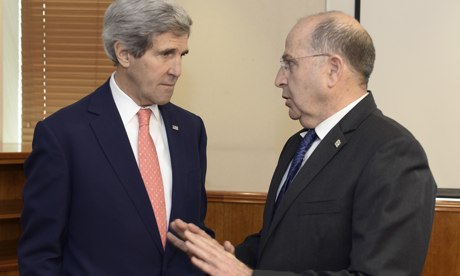
'It is a pity the US State Department chose to focus this week on the private remarks of Israel's Minister of Defence [Moshe Ya'alon] labelling US Secretary of State John Kerry as being delusional and messianic – rather than concentrating on PLO Chairman Abbas's very public remarks in the Jerusalem Post that go to the heart of the 130 years old Jewish-Arab conflict:
"Israel's problem is that the Palestinians know more than the Israelis about history and geography. We talk about what we know"
Is Abbas correct in his contention or has he become a victim of his own propaganda?

The answer depends on how one views Abbas's following statement to the United Nations on 26 September 2013:
"However, as representatives of the Palestinian people, we have long been aware of our responsibilities towards our people and had the necessary courage to accept a two-State solution: Palestine and Israel on the borders of 4 June 1967, establishing a Palestinian State on 22 per cent of the land of historic Palestine."
Are the West Bank and Gaza in fact 22 per cent of historic Palestine or do they comprise only 5 per cent of historic Palestine?

The answer to that question first involves an answer to this question:

"Is Jordan 78 per cent of historic Palestine – as the PLO Charter claims – or is Israel 78 per cent of historic Palestine – as Abbas suggested at the United Nations?"
Resolution of the conflict will stand a far greater chance of success – and be more enduring
– if Jews and Arabs can first reach a consensus in answering this fundamental question.
That is a challenge that should excite Kerry as he seeks to find a way through the complexities of a conflict whose solution has eluded so many eminent people, organisations and Committees before him – including those appointed by both the League of Nations and the United Nations.

Agreement that Jordan comprises 78 per cent of historic Palestine would greatly enlarge the territorial field within which the Jewish-Arab conflict can be resolved – making the conflict much easier to settle.

Jordan's inclusion could materially advance the prospects for the creation of a new Arab state between Israel and Jordan  – the subject of the current negotiations – or open up other alternative solutions to end the conflict if they fail – which seems destined to happen.


Kerry needs to urgently determine if there is any consensus between Israel, the PLO and the Arab League on the history and geography of "Palestine".

History books and atlases can be used to resolve any disagreements – supported by eminent historians and geographers well qualified to express their opinions.

To achieve this end result Kerry could instruct his State Department to prepare a questionnaire for Israel, the PLO and the Arab League to complete by a specified date.

To ensure the process is fair and transparent, Kerry could recommend that a panel be constituted comprising Kerry as Chairman and six history and geography experts – three appointed by Israel and three by the PLO and the Arab League – with Kerry holding a casting vote should the experts be equally divided.


The questionnaire could possibly include these questions:

1. When was "Palestine" first so named and by whom?

2. Was the name of "Palestine" prior to its change "Eretz Yisrael"?

3. When was "Eretz Yisrael" so named and by whom?

4. Is Israel 78 per cent of "Palestine" or only 17 per cent of "Palestine"?

5. Is Jordan 78 per cent of "Palestine" or does it form no part of "Palestine"?

6. Is the "West Bank" 22 per cent of "Palestine" or 4 per cent of "Palestine"?

7. When was the "West Bank" first so named and by whom?

8. Was the name of the "West Bank" prior to its change "Judea and Samaria"?

9. When was "Judea and Samaria" so named and by whom?

10. When was "Jordan" first so named and by whom?

11. When were "Palestine's borders" first defined and where were they located?

12. Did the Mandate for Palestine include what is today called Israel, Jordan, the West Bank and Gaza?

13. Were the West Bank and Transjordan unified into a single territorial unit between 1950 and 1967?

14. Where was the border between Israel and Jordan immediately prior to the outbreak of the 1967 Six Day War?

15. What date did the Arab residents of the West Bank become Jordanian citizens and on what date was their Jordanian citizenship terminated?

16. What settlements were established by Jews in the West Bank prior to 1948?

17. Who was the last sovereign power to legally occupy the West Bank and for what period did such occupation last?

18. On what date and in what part of Palestine were the provisions of the Mandate for Palestine relating to the reconstitution of the Jewish national Home in Palestine postponed or withheld?


The questionnaire would seek to flesh out the extent to which Jewish and Arab historic and geographic narratives coincide – with the objective of eventually reaching a joint consensus in answering the questions posed.

The questionnaire should be answered by Israel, the PLO and the Arab League before Kerry presents Israel and the PLO with his proposed framework agreement for peace.

If the parties cannot first agree on the territory within which the Jewish-Arab conflict is to be resolved, how can meaningful and serious discussions on Kerry's framework agreement even be contemplated or commenced?

Kerry needs to focus on this issue – rather than concerning himself with negative comments affecting him personally.

Abbas's claimed knowledge of history and geography needs to be tested.

The result could be Kerry's key to ending the current deadlock and resolving the conflict.