Eretz Israel is our unforgettable historic homeland...The Jews who will it shall achieve their State...And whatever we attempt there for our own benefit will redound mightily and beneficially to the good of all mankind. (Theodor Herzl, DerJudenstaat, 1896)

We offer peace and amity to all the neighbouring states and their peoples, and invite them to cooperate with the independent Jewish nation for the common good of all. The State of Israel is ready to contribute its full share to the peaceful progress and development of the Middle East.
(From Proclamation of the State of Israel, 5 Iyar 5708; 14 May 1948)

With a liberal democratic political system operating under the rule of law, a flourishing market economy producing technological innovation to the benefit of the wider world, and a population as educated and cultured as anywhere in Europe or North America, Israel is a normal Western country with a right to be treated as such in the community of nations.... For the global jihad, Israel may be the first objective. But it will not be the last. (Friends of Israel Initiative)
Showing posts with label Israel and the Disputed Territories. Show all posts

Monday, 23 June 2014

"Islamic and Arab Countries Fiddle While Syria Burns": David Singer on bully boy tactics against Australia regarding The O Word

Titled "Palestine – Islamic and Arab Countries Fiddle While Syria Burns", this is the latest article by Sydney lawyer and international affairs analyst David Singer.

He writes:

Australia’s decision on 5 June to no longer refer to East Jerusalem and the West Bank as “occupied territory” but rather “disputed territory” has provoked outrage among Islamic and Arab countries accredited in Australia.

They sought and received an urgent meeting with Australia’s Foreign Minister Julie Bishop on 19 June – following a letter sent to Ms Bishop on 12 June by Moroccan Ambassador HE Mohamed Mael-Ainin on behalf of the Heads of Mission of this powerful Islamic lobby.

The Ambassador’s letter has not been released by the Foreign Affairs Department as it:
“does not publicly release correspondence to the Foreign Minister from representatives of foreign countries.”
Yet – in a media release issued after the meeting – Ms Bishop attached her written response to the Moroccan Ambassador, in which she stated:
“I emphasise that there has been no change in the Australian Government's position on the legal status of the Palestinian Territories, including East Jerusalem. Our position is consistent with relevant UN resolutions on the issue, adopted over many years, starting with UN Security Council Resolutions 242 and 338. Senator Brandis' statement was about nomenclature, and was not a comment on the legal status of the Palestinian Territories.
Australia continues to be a strong supporter of a just and lasting two-state solution, with Israel and a Palestinian state existing side by side in peace and security, within internationally recognised borders. To this end, we are urging both sides to resume direct negotiations. We do not consider it helpful to engage in debates over legal issues, nor to prejudge any final status issues that are the subject of these negotiations.”
Creating a second Arab State in Mandatory Palestine – in addition to Jordan – for the first time ever in recorded history remains an illusion after fruitless negotiations spanning the last 20 years.
Legal issues will determine final status issues – one essential legal prerequisite being secure and recognized borders for Israel demanded by Resolutions 242 and 338

The Palestine Liberation Organisation’s acceptance of the League of Nations and United Nations decisions recognising the right of the Jewish people to reconstitute the Jewish National Home in Mandatory Palestine remains another legal lynch pin to achieving Australia’s desired two-state solution.

Refusal to recognise the State of Israel by all 57 member states of the Organisation of Islamic Cooperation (OIC) has materially contributed to the 130-years-old Jewish-Arab conflict remaining unresolved.

Photo by Andrew Meares; from SMH
Jordan’s Ambassador Rima Ahmad Alaadeen (on the right of this Sydney Morning Herald photo by Andrew Meares), after meeting Ms Bishop reportedly made the OIC’s potential hostility towards Australia very clear:
“Alaadeen said she could not say whether there would be trade sanctions against Australia. The controversy was on the agenda of the 57-state Organization of Islamic Cooperation summit of foreign ministers in Jeddah this week.
“There is a clause or a paragraph … on the recent events in Australian policy regarding East Jerusalem, so we have to wait and see what transpires,” she said.
Iraq’s Ambassador to Australia, Mouayed Saleh, who also attended the meeting, similarly said he could not rule out trade sanctions.”
In pursuing this diplomatic dressing down of Australia including threats of sanctions for having the temerity to pursue its own independent foreign policy – these Islamic and Arab States missed a golden opportunity to raise with Ms Bishop a shocking Report released on 16 June by the Human Rights Council received from its “Independent International Commission of Inquiry on the Syrian Arab Republic” – a fellow Arab and Islamic State.
 
The Report – detailing developments in the ongoing conflict between 15 March and 15 June – states:
“In three years of conflict, millions of Syrians have suffered the loss of relatives to attacks, to violence in detention facilities, to disappearances and to starvation. Hundreds of thousands have lost their lives. The failure to protect civilians, both from the conduct of the Syrian Government forces and non-State armed groups unaligned with the Government (NSAGs), has led to unspeakable suffering. An estimated 9.3 million Syrians are in need of urgent humanitarian assistance, with 4.25 million IDPs and 2.8 million refugees in neighbouring countries. The vast majority are women and children.
In the course of the conflict, the infrastructure that constitutes civilian life has been targeted and misused. Schools have been reduced to rubble or occupied by armed forces, hospitals have come under attack, and entire residential neighbourhoods have been destroyed.”
Horrors being currently perpetrated include:
Extra-judicial killings, sexual assaults, beatings, enforced disappearances and arbitrary arrests
Reports of deaths in custody, particularly in detention centres in Damascus city, rising dramatically. Former detainees described being held in cells with corpses of cellmates who had been tortured or died as a result of untreated medical conditions.
Persistent reports of the use of torture – including beating, electrocution and hanging from walls. Increasing attacks by Government forces and the armed opposition targeting civilians.
Australia is presently a member of the UN Security Council.

The Report states that through UN inaction:
“a space has been created for the worst of humanity to express itself.”
Those Islamic and Arab diplomats meeting Ms Bishop should have been urging Australia to sponsor a Security Council resolution demanding that an armed UN force be sent to Syria to implement an imposed cease fire to end this mayhem and slaughter.

Regrettably, imposing bully boy tactics on Australia was obviously considered far more important than trying to end the interminable suffering of millions of their Syrian Arab brethren and sisters.

Go figure.

Monday, 16 June 2014

David Singer: "Palestine – Negotiating Semantic Minefield Becomes Pressing Necessity"

Here is the latest article by Sydney lawyer and international affairs analyst David Singer.

He writes:

Two former [Labor] Australian Foreign Ministers – Bob Carr (2012-2013) and Gareth Evans (1988-1996) – have published an article this past week engaging in a semantic tug of war with Australia’s current [Liberal] Foreign Minister – Julie Bishop  – over Australia’s recently declared policy of refusing to describe East Jerusalem as “occupied territory”.

East Jerusalem and Judea and Samaria were conquered in 1948 by Transjordan and illegally annexed in 1950  – when Transjordan then changed its name to “Jordan” and the 3000 years old geographic designation of “Judea and Samaria” to the “West Bank”.

East Jerusalem and the West Bank were lost by Jordan to Israel in the 1967 Six Day War.

In 1980, the Israeli Knesset passed a Basic Law declaring reunified Jerusalem the eternal capital of Israel, while providing for freedom of access to each religion's holy sites – a decision not sanctioned by the United Nations.

“Occupied territory” carries the clear connotation that such territory indisputably belongs to someone else. Yet East Jerusalem and the West Bank have not been under any internationally recognised sovereignty or control since Great Britain handed back its administration of the Mandate for Palestine to the United Nations in 1948. Israel refers to the West Bank as “disputed territory”: 
“The West Bank and Gaza Strip are disputed territories whose status can only be determined through negotiations. Occupied territories are territories captured in war from an established and recognized sovereign. As the West Bank and Gaza Strip were not under the legitimate and recognized sovereignty of any state prior to the Six Day War, they should not be considered occupied territories.
The people of Israel have ancient ties to the territories, as well as a continuous centuries-old presence there. These areas were the cradle of Jewish civilization. Israel has rights in the West Bank and Gaza Strip, rights that the Palestinians deliberately disregard.”
Australia’s Prime Minister, Tony Abbott, agrees: 
“It is important, as far as you can, not to use loaded terms, not to use pejorative terms, not to use terms which suggest that matters have been prejudged and that is a freighted term.
The truth is they’re disputed territories.”
Carr and Evans conveniently overlook mentioning or rebutting Israel’s position – indicating a level of intellectual dishonesty which is disappointing coming from persons with such distinguished backgrounds.

Instead, Carr and Evans ring the alarm bells – attempting to incite a state of international hysteria when claiming:
“If East Jerusalem is not to be referred to as “occupied”, why not Nablus or Bethlehem? If the Australian government can say “occupied East Jerusalem” is fraught with “pejorative implications” what is to stop Ms Bishop applying this to the occupied West Bank as a whole? It is a short step away for the Coalition government to declare that all the West Bank, with its population of more than 2 million Arabs, is no more than a “disputed" territory.'
Are they really unaware that 40 per cent of the West Bank – including Nablus and Bethlehem - contains 96 per cent of the West Bank Arab population – and has been under the total administrative control of the Palestine Liberation Organisation since 1995?

Have they forgotten that Israel offered to cede its claims to sovereignty in more than 90 per cent of the West Bank to the Palestinian Authority in 2000/2001 and 2008 – and that both offers were rejected.

Carr and Evans aren’t averse in misleading their readership when they assert:
“The International Court of Justice in 2004 declared not only that the West Bank was occupied but that this was illegal.”
It is unseemly that they forget to mention that this decision was an Advisory Opinion only and has no binding legal effect.

What is completely inexcusable is that Carr and Evans relied only on this International Court of Justice decision – whilst apparently failing to consider the following established international law with specific application to the West Bank – namely:
1. The Mandate for Palestine 1922 – especially article 6 – and article 80 of the United Nations Charter; and
2. Security Council Resolutions 242 and 338
These provisions provide the legal basis for Israel using the term “disputed territory” and Australia rejecting the pejorative term “occupied territory” used in countless UN Resolutions – misleadingly suggesting an Arab entitlement to 100 per cent exclusive sovereignty.

The Arab-Jewish conflict has been an ongoing battle of words as much as a series of real live battles fought by the Jews against its Palestinian Arab neighbours, the armies of six Arab States and a myriad number of terrorist groups over the last 130 years.

Notable semantic battles that have influenced the political debate include:
1. Do the words “in Palestine” as used in the Mandate for Palestine mean “all of Palestine”?
2. Do the words “Withdraw from territories” used in Security Council Resolution 242 mean “all the territories”?
3. Are there “1967 borders” or only “1967 armistice lines”?
4. Did the words “Reconstitute the Jewish National Home” as used in the Mandate for Palestine preclude the creation of a Jewish State?
5. Does “Palestine” include what is today called “Jordan”?
Whilst one side talks “occupied territory” and the other “disputed territory”,  negotiations will continue to go nowhere. A pathway through this semantic minefield needs to be found which leads to the parties using commonly agreed and understood language.

If not, this minefield could blow up with disastrous consequences for everyone – not just the disputants.

Another Syria or Iraq is the last thing the world needs now.

Monday, 9 June 2014

David Singer On Why The O Word Is Odious: "The world has been duped into the use of language that reflects fiction – not fact"

In this, his latest article, "Palestine – Australia Rejects Fiction To Recognise Reality", Sydney lawyer and international affairs analyst David Singer explains why Australia's avoidance of the O word is commendable and worthy of emulation.

Writes David Singer:


Australia will no longer be referring to East Jerusalem and the West Bank (Judea and Samaria) as "occupied territories".

Attorney-General George Brandis made this clear when he read a statement to the Senate Foreign Affairs Committee this week indicating the language of "occupation" was:
“judgmental”, “freighted with pejorative implications” and “neither appropriate nor useful” for the peace process.
This injection of sanity into the contribution being made by the international community to help resolve the 130-years-old Arab-Jewish conflict is long overdue and very welcome.

The use of the terms "Occupied Territories" by the European Union or "Occupied Palestinian Territories" by the United Nations has emboldened the Arab League, the Palestine Liberation Organisation (PLO) and the Palestinian Authority (PA) to maintain their 47-year-old demand that every square metre of land captured by Israel from Jordan in the 1967 Six Day War be returned to Arab control.

Their unyielding stance was never contemplated by Security Council Resolution 242 which acknowledged the right of Israel to exist within secure and recognised borders. It has been a major impediment to resolving the Arab-Jewish conflict  –  resulting in offers by Israel to cede its claims to sovereignty in more than 90 per cent of those territories being rejected by the PA in 2000/1 and 2008.

Catherine Ashton – High Representative of the Union for Foreign Affairs and Security Policy European Union/Vice-President of the European Commission – was pandering to this decades-old Arab demand when she told the European Parliament in Strasbourg on 30 December 2009:
"East Jerusalem is occupied territory, together with the rest of the West Bank.”
Israel’s then Deputy Foreign Minister, Danny Ayalon, penned an article in response in the Wall Street Journal on 30 December 2009 – pointing out: 
"However, little appears to be truly understood about Israel's rights to what are generally called the "occupied territories" but what really are "disputed territories."
That’s because the land now known as the West Bank cannot be considered "occupied" in the legal sense of the word as it had not attained recognized sovereignty before Israel’s conquest. Contrary to some beliefs there has never been a Palestinian state, and no other nation has ever established Jerusalem as its capital despite it being under Islamic control for hundreds of years.”
Ayalon criticised the perception that:
“... Israel is occupying stolen land and that the Palestinians are the only party with national, legal and historic rights to it. Not only is this morally and factually incorrect, but the more this narrative is being accepted, the less likely the Palestinians feel the need to come to the negotiating table.”
Ayalon was affirming that the West Bank was “no man’s land” – where sovereignty still remained undetermined.

Israel and the PLO –  the PA having been disbanded in January 2013 – still continue to be unable to agree on the final allocation of sovereignty after fruitless negotiations spanning the last 20 years.

The latest round of negotiations ended in total collapse on 29 April with the PLO still demanding sovereignty in 100 per cent of the territories (or perhaps – as has been reported – some land swaps in compensation).

Ayalon's prediction in 2009 has proved to be chillingly correct in 2014 – and will continue to prevail whilst the PLO refuses to acknowledge that Israel has any claims to sovereignty in these areas.

Such claims are based on legal rights vested in the Jewish people pursuant to Articles 94 and 95 of the 1920 Treaty of Sevres, Article 6 of the League of Nations Mandate for Palestine 1920 and Article 80 of the United Nations Charter.

The PLO considers such rights to be "null and void" under Article 20 of the PLO Covenant – seeking to snuff out Israel's claims to what was the heart of the Jewish biblical and ancestral homeland 3000 years ago.

Ignoring this body of international law spells disaster for Israel and the PLO ever resolving their competing claims.

Australia's decision to call a spade a spade will hopefully encourage other countries to follow suit – as well as implementing international action to make some further changes in the duplicitous diplomatic double speak involving the use of misleading and deceptive language which has hindered rather than facilitated any resolution of the conflict.

These changes include:
1. Replacing the term "occupied territories" with the term "disputed territories" to clarify that Jews also have legal rights in these territories in addition to those claimed by the Arabs.
2. Using the 3000 years old term "Judea and Samaria" to replace the term "West Bank" – first coined by Jordan in 1950 to erase any trace of Jews having lived there after having been driven out by the invading Jordanian army in 1948.
3. Substituting "Palestinian Arabs" for "Palestinians" and "Palestinian people" – terms first appearing in the 1964 PLO Charter that excluded former Jewish and other non-Arab residents and their descendants having any rights.
4. Referring to the conflict as the "Jewish-Arab conflict" – which commenced in about 1880 instead of the "Palestinian-Israeli " conflict – which only commenced in 1948.
5. Omitting any reference to the term "State of Palestine" until the provisions of the Montevideo Convention 1934 are complied with.
The world has been duped into the use of language that reflects fiction – not fact. Used often enough it takes on a highly damaging life of its own.

Erasing such language from the international lexicon is long overdue.

The world's nations need to awaken from their fiction-induced slumber.

Saturday, 7 June 2014

"Occupied Palestinian Territories": Brandis Riles Rhiannon

In this video veteran pro-BDS stalwart Aussie Greens Senator Lee Rhiannon, the daughter of Stalinist parents, one of them of Jewish extraction, is deliciously put down and accordingly flummoxed by federal Attorney-General George Brandis when she uses the word "occupied" in relation to East Jerusalem and the "Palestinian Territories".
She: "Why did the Australian Ambassador to Israel attend a meeting in occupied East Jerusalem with the Israeli minister for housing and construction; the same minister who is forecasting a 50 per cent increase in settlements in the Occupied Palestinian Territories in the next five years?"
 He: 'Well I think I should say, Senator Rhiannon, that the rather tendentious way in which you've put that question and in particular the use of the word "occupied" is not something that the Australian Government of either political persuasion acknowledges or accepts.'
She: 'So you don't use the term "Occupied Palestinian Territories", even though it's a United Nations term used widely by a number of international agencies, European members et cetera…'
He: 'Well it's used by a lot of people. It's used by a lot of communists too. Weren't you a member of the Communist Party once?'
Naturally, Australia's lefties and leftist press are much perturbed at Brandis's stance and what it implies about current Australian government policy, as seen here and here and here

See also here and  here

(Hat tip: readers Ian and Marvin)

The PLO's Dr Hanan Ashwari denounces Brandis's comments thus:
“It is absolutely disgraceful and shocking that on the 47th anniversary of Israel’s military occupation of the West Bank (including East Jerusalem), and Gaza, Australian Attorney-General George Brandis is issuing such inflammatory and irresponsible statements that ‘occupied East Jerusalem’ is ‘a term freighted with pejorative implications, which is neither appropriate nor useful.’  Such pronouncements are not only in blatant violation of international law and global consensus, but are also lethal in any pursuit of peace and toxic to any attempt at enacting a global rule of law.
Israel’s illegal annexation of East Jerusalem is beyond ‘pejorative’ and ‘inappropriate’; it is a deliberate and egregious violation, not just of international humanitarian law and consensus, but of the basic norms of responsible behavior that governs relations among civilized states.”
Trying to fabricate or distort the law to fit Israel’s lawless behavior is shameful and dangerous.  Attorney-General Brandis, whether out of ignorance or whether out of blind bias, is trying to render Australia complicit in the Israeli occupation, and is forcing it to become an advocate of international criminal behavior”.
From Eli E. Hertz of the Myths and Facts website, a timely item:
'The term “occupied territory,” which appears in the Fourth Geneva Convention, originated as a result of the Nazi occupation of Europe. Though it has become common parlance to describe the West Bank and Gaza as “occupied territories,” there is no legal basis for using this term in connection to the Arab-Israeli conflict.
[University of Sydney] Professor Julius Stone, a leading authority on the Law of Nations, categorically rejected the use of the term “occupied territory” to describe the territories controlled by Israel on the following counts:
(1) Article 49 relates to the invasion of sovereign states and is inapplicable because the West Bank did not and does not belong to any other state.
(2) The drafting history of Article 49 [Protection of Civilian Persons in Time of War] – that is, preventing “genocidal objectives” must be taken into account. Those conditions do not exist in Israel’s case.
(3) Settlement of Jews in the West Bank is voluntary and does not displace local inhabitants. Moreover, Stone asserted: that “no serious dilution (much less extinction) of native populations” [exists]; rather “a dramatic improvement in the economic situation of the [local Palestinian] inhabitants since 1967 [has occurred].”
 See all of Hertz's article here

Monday, 20 January 2014

Kerry's Key to Ending the Current Deadlock? David Singer Explains ...

Entitled  "Palestine History and Geography Can Unblock Deadlock", here's the latest article by Sydney lawyer and international affairs analyst David Singer.

He writes:

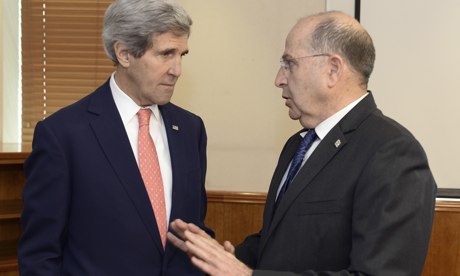
'It is a pity the US State Department chose to focus this week on the private remarks of Israel's Minister of Defence [Moshe Ya'alon] labelling US Secretary of State John Kerry as being delusional and messianic rather than concentrating on PLO Chairman Abbas's very public remarks in the Jerusalem Post that go to the heart of the 130 years old Jewish-Arab conflict:
"Israel's problem is that the Palestinians know more than the Israelis about history and geography. We talk about what we know"
Is Abbas correct in his contention or has he become a victim of his own propaganda?

The answer depends on how one views Abbas's following statement to the United Nations on 26 September 2013:
"However, as representatives of the Palestinian people, we have long been aware of our responsibilities towards our people and had the necessary courage to accept a two-State solution: Palestine and Israel on the borders of 4 June 1967, establishing a Palestinian State on 22 per cent of the land of historic Palestine."
Are the West Bank and Gaza in fact 22 per cent of historic Palestine or do they comprise only 5 per cent of historic Palestine?

The answer to that question first involves an answer to this question:

"Is Jordan 78 per cent of historic Palestine as the PLO Charter claims or is Israel 78 per cent of historic Palestine as Abbas suggested at the United Nations?"
Resolution of the conflict will stand a far greater chance of success and be more enduring
if Jews and Arabs can first reach a consensus in answering this fundamental question.
That is a challenge that should excite Kerry as he seeks to find a way through the complexities of a conflict whose solution has eluded so many eminent people, organisations and Committees before him including those appointed by both the League of Nations and the United Nations.

Agreement that Jordan comprises 78 per cent of historic Palestine would greatly enlarge the territorial field within which the Jewish-Arab conflict can be resolved making the conflict much easier to settle.

Jordan's inclusion could materially advance the prospects for the creation of a new Arab state between Israel and Jordan  the subject of the current negotiations or open up other alternative solutions to end the conflict if they fail which seems destined to happen.


Kerry needs to urgently determine if there is any consensus between Israel, the PLO and the Arab League on the history and geography of "Palestine".

History books and atlases can be used to resolve any disagreements supported by eminent historians and geographers well qualified to express their opinions.

To achieve this end result Kerry could instruct his State Department to prepare a questionnaire for Israel, the PLO and the Arab League to complete by a specified date.

To ensure the process is fair and transparent, Kerry could recommend that a panel be constituted comprising Kerry as Chairman and six history and geography experts three appointed by Israel and three by the PLO and the Arab League with Kerry holding a casting vote should the experts be equally divided.


The questionnaire could possibly include these questions:

1. When was "Palestine" first so named and by whom?

2. Was the name of "Palestine" prior to its change "Eretz Yisrael"?

3. When was "Eretz Yisrael" so named and by whom?

4. Is Israel 78 per cent of "Palestine" or only 17 per cent of "Palestine"?

5. Is Jordan 78 per cent of "Palestine" or does it form no part of "Palestine"?

6. Is the "West Bank" 22 per cent of "Palestine" or 4 per cent of "Palestine"?

7. When was the "West Bank" first so named and by whom?

8. Was the name of the "West Bank" prior to its change "Judea and Samaria"?

9. When was "Judea and Samaria" so named and by whom?

10. When was "Jordan" first so named and by whom?

11. When were "Palestine's borders" first defined and where were they located?

12. Did the Mandate for Palestine include what is today called Israel, Jordan, the West Bank and Gaza?

13. Were the West Bank and Transjordan unified into a single territorial unit between 1950 and 1967?

14. Where was the border between Israel and Jordan immediately prior to the outbreak of the 1967 Six Day War?

15. What date did the Arab residents of the West Bank become Jordanian citizens and on what date was their Jordanian citizenship terminated?

16. What settlements were established by Jews in the West Bank prior to 1948?

17. Who was the last sovereign power to legally occupy the West Bank and for what period did such occupation last?

18. On what date and in what part of Palestine were the provisions of the Mandate for Palestine relating to the reconstitution of the Jewish national Home in Palestine postponed or withheld?


The questionnaire would seek to flesh out the extent to which Jewish and Arab historic and geographic narratives coincide with the objective of eventually reaching a joint consensus in answering the questions posed.

The questionnaire should be answered by Israel, the PLO and the Arab League before Kerry presents Israel and the PLO with his proposed framework agreement for peace.

If the parties cannot first agree on the territory within which the Jewish-Arab conflict is to be resolved, how can meaningful and serious discussions on Kerry's framework agreement even be contemplated or commenced?

Kerry needs to focus on this issue rather than concerning himself with negative comments affecting him personally.

Abbas's claimed knowledge of history and geography needs to be tested.

The result could be Kerry's key to ending the current deadlock and resolving the conflict.